
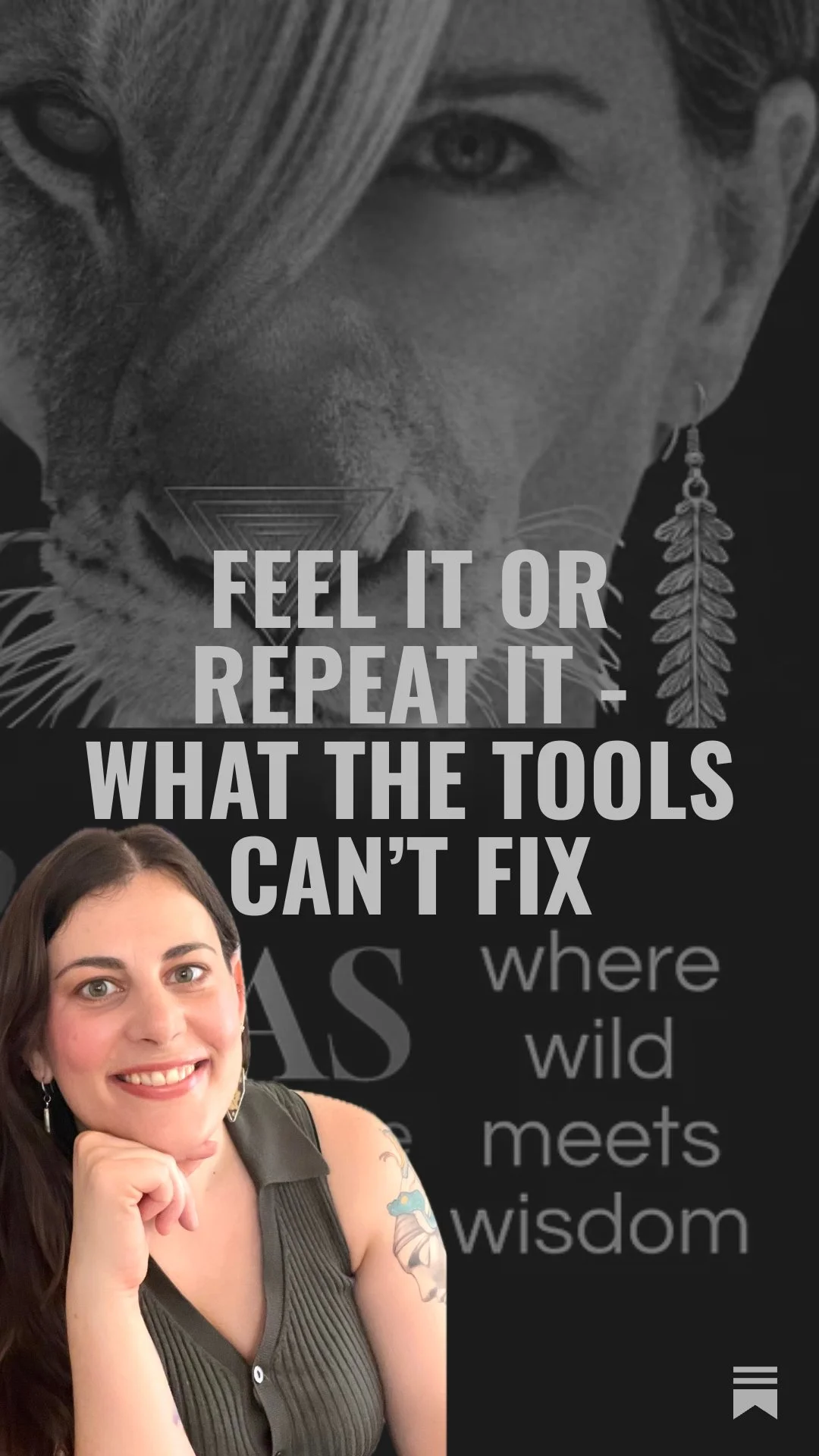
Sabrina Mabel is an a Trauma Responsive Emotional Intelligence coach with a Master of Education in Developmental Psychology and the host of the new Emotional Embrace podcast. As an educator, a Reiki master, a channel, and a recovering addict she found that the thread connecting all of it is the same thing she saw missing in her kindergarten classroom on day one: the emotional embrace. This conversation is about why most healing skips the one thing that actually works.
Note: this episode contains a brief disclosure of suicidal ideation. Please listen with care if this is sensitive territory for you.
Sabrina Mabel guides women to heal trauma, burn out and emotional overwhelm by embracing their emotions with her signature TEAM method.
She is a Trauma Responsive Emotional Intelligence coach with a Master of Education in Developmental Psychology and the host of the new Emotional Embrace podcast.
Instagram: https://www.instagram.com/iamsabrinamabel/
website: https://sabrinamabel.podia.com/
Full Transcript:
Sabrina, why do you feel so deeply, strongly that this is the work?
Well, I'll start with where I first saw that emotional embrace, or then I would call social emotional learning or emotional intelligence, was missing. In hindsight, I can see it's for my inner child. It's also about me healing my own wounds of childhood. But I am in first career an elementary school teacher and I taught kindergarten to grade six as well as a little bit of middle school. And I can tell you that I was the keenest teacher ever. Even in high school I used to ask my French teacher to give me opportunities to teach in her class for younger students. And when I was in college in Quebec, I was like, oh I won't study education because I already know that's what I'll do, so I'll just study my own passion which was philosophy and history.
And by the time I was doing my Bachelor of Education, I was really trained to plan, assess, differentiate. We talk about helping students with behavioral issues and supporting students with differences, but never once that I can remember did we ever talk about emotions. I think I was actually a highly trained teacher. I did my bachelors at McGill and I loved my program. I think I was very well trained to become a teacher. But my first year in Toronto I taught at a French school and even though I had all the resources, this was a private school, all the environment set up and all the training, what kept coming up was it doesn't matter how prepared I am, these children are not ready to learn. Not because they don't want to, not because kids aren't inclined with curiosity and inquiry to learn and ask questions, but because they were showing up at four or five years old, anxious, overwhelmed. They would come into the class and they didn't want to learn math. They wanted to talk about their little fight at recess with their best friend. That's what was bothering them.
And that very first year I could see I could do all the professional development but there's something here I don't know as a professional around social emotional learning and I am not reaching my students the way I want to. This was very intuitive. And I decided to go back to school and do my masters of education in developmental psychology. And even then it was still very cerebral. And as I went along, I felt this doesn't feel right. This doesn't even interest me. This is not even related to the real classroom. And somewhere along the way I ended up in courses in mindful compassion, healing trauma through holistic modalities like art, spirituality in education, holistic education, play in education. And this led me to being really, really interested in the emotions. This was just like the seed was planted. And I still didn't even have the words to express yet that this was emotional intelligence, but that was the missing that I saw.
And especially the parent community would bring all of their emotions into everything related to their child and education. And I realized that I could intervene as much as I could with the child and support them and teach them ways to let go of all their energy and their big emotions. But then they would go back home, go back to the weekend, and almost just like be imprinted with even more emotion, even more difficult things. And I was like, it's not the burden on the children. It's not for the children to become emotionally intelligent and do all the work. The adults need this too. And so that is where it all began.
Wow, that's beautiful. That's so perfect. Because what I was just going to ask you was, were the kids carrying their parents' stuff back into the classroom? So the deconstruction needs to happen with the adults first. For you, because you have a traditional education in these areas, but I know you also have some very untraditional background. How did these two parts end up weaving together for you?
Yes, and this is where all the dots connected. So when I was doing my Master of Education, I was also dealing with a lot of my own personal issues. I was someone who was a high functioning addict. I was incredibly successful in my career. I was doing a master's. I was very good at my job. I was being very well evaluated. And yet on the weekend I was going partying and using drugs and just really struggling and feeling like I was constantly on edge and just about to fall apart.
And I always found myself in these really chaotic traumatic situations with the men that I had relationships with, and I just knew this is not healthy. And at the same time that exact year I had started my Reiki training. I received my Reiki level one and two, I believe, at that time. And it was interesting because it would bring me to this path of light and this path of embracing my intuitive gifts. I'm a channel, I'm an oracle. And all of this was surfacing but it was also bringing up the shadows. This drug addiction, and every time I would stop then I would go back to it. And I felt like my entire life I was parentified. I acted like a little adult as a little child. And of course I became a teacher and I had all this pressure and burden and I felt like I was all alone and nobody knew my pain.
I even remember expressing to adults in my life, I have a cocaine addiction. And they literally were like, oh you're fine, you'll figure it out. You're the rock of the family, you'll be fine. And that was my very direct clear call out for help. Like I am not okay. And most people with addiction or dependency on these types of substances won't even admit that. But I was so clear. I was like this is not healthy, this is not a healthy way to cope. So I took a year off of my job, decided to sell all my stuff, buy a traveling backpack, go traveling, and just take a break from my master's. Something in me was like I need to not be responsible. And I literally went on a nine-week trip to Europe, the find yourself in Euro trip. And I just let myself completely be me. I partied, I did drugs, I drank, I met people. But I also sat in a meadow and connected with nature and fairy energy and I would give myself oracle readings and give it to others. It was like this complete mix of the shadow and the light all together.
And when I came back I knew I needed drug addiction therapy. In fact I stopped all by myself and I had a psychosis. I went to the hospital and nobody could help me. They were like, you imagined everything that happened to you. And I was like, no I did not imagine this. And by myself I went to CAMH, which is the Centre for Addiction and Mental Health in Toronto. They provide outpatient care, you just come once a week, it's free. And I chose to be in a group for mental health and addiction and I stayed in this group for nine months where you have to commit to being sober and if you're not you have to be honest about it. And I learned so much more about trauma, the trauma in my own life. I learned the correlation between addiction and mental health. I learned how to ground. And through this journey I completed my master of education and I completed my Reiki teacher certification. And it was like everything in my life came together holistically.
I had the background with the masters. I had the spiritual energetic work. I had more of what I would say science-backed healing modalities like mindful compassion and grounding, a little bit of the neuroscience behind it all. And it started to all come together. And as I healed and I took on my own Reiki students, it was right in front of me. People want healing or they escape. And what they're all avoiding, whether it's in a ceremony with ayahuasca or in Reiki or at a party with alcohol, they're all escaping their emotions. And it was so clear. It was like we don't need more spirituality, we don't need more academic, we need the emotional embrace.
Speak to me about being in ceremony and that being an emotional escape.
Where can I begin. I'm going to speak to my experience and I understand that there are many ceremony holders and people who go in ceremony and do have emotional releases and do emotionally embrace. But especially as a reflector I have seen that a lot of it is used to reach a high or feel like we are ascending or more morally ahead of others instead of actually descending into our humanness and our emotions.
From my experience, I started off around 2015, 2016, where I started to join spiritual communities in Toronto. And every single event I went to, whether it was ecstatic dance or cacao, even some Reiki ceremonies, I felt it was so cerebral. It was all about knowledge and knowing more and being a perfect teacher and having more certifications. And it was very cerebral. It was so many people with trauma, with absolutely no boundaries, a lot of inappropriate touch with no rules around touch. And it was like seeing things like cuddle puddles and people dancing and just touching each other and no rules were set. And it was all these people with big emotions, with all this trauma, trying to reach some sense of peace or ecstasy through these very open-ended experiences. But no one was crying, no one was saying I'm angry. It was all just like peace, love, gratitude. And it was just such a clear bypassing of what actually people are dealing with.
So it's not just the emotional piece, it's also the bypassing of trauma and our humanness and the error, flaw in being human and embracing that. I felt like it was all these people just wanting to become goddesses and gurus to skip over being human. And then I saw this in Mexico, and I experienced this with clients that were coming from all over the world because I taught Reiki in Mexico as well with expats. And it was the same thing. The more I worked with spiritual people, the more I saw there was such a high horse, like I'm on top of the world attitude. And I was like, this is not it. And I stepped away from everything. I was making money but I stepped away and I said I don't want to be part of this. This is not for me. And there's something else I'm here to offer.
I hear and have experienced exactly what you're saying. And unfortunately we don't know what we don't know and we go in with good intentions. I for example was in a school for over five years with no knowledge of the level of trauma that I was acting out, and no one had the background to point it out to me. And once that finally landed, everything began to shift. But until we can address that trauma, and I know everybody's talking about it ad nauseum, it's such a freaking essential piece that needs to be addressed.
What I don't fully understand myself, my understanding from Bessel van der Kolk's book that we've talked about, is that the trauma that happens before the age of seven changes the brain chemistry. And most of the people dealing in personal development work in the world understand little t trauma. And the ability for us with the proper tools to shift big T trauma is a different animal. And where can we feel embraced by the work that's out there and available to us, and feel seen and held, and experience an appreciable shift in that trauma state relative to the depth of what some people are carrying.
I'm hearing quite a few things in that. And the first thing I want to mention is I think part of this is systemic. I can only speak to my experience in Canada and my experience living in Mexico. I think first of all, I actually don't think a lot of people are aware of little t trauma. I think there's actually still a lot of stigma or belittling of things that have happened to us. In my case, for example, I didn't know that I experienced trauma in my childhood until a social worker at this addiction center told me, these are not normal things to experience. And what I learned is that anything that is not within the developmental stage that is meant to be part of that developmental stage, if you're exposed to that, that is trauma. So in my case, I was exposed to hypersexualization. There were adults in my life talking too openly about sex and not having boundaries around their dating life in the home. I want to respect the people in my life and I don't want to say too much on that, but what I learned was that that is a form of small t trauma and I didn't know that.
Even things, and a lot of people will disagree, spanking is traumatic, physical violence is traumatic. And I think one of the biggest differences is some people experienced it as traumatic, their body immediately knew this is not safe, this is not okay. And often we experience it as shame before the age of seven. And others, psychologically, they protect the person who hurt them and they justify spanking for example and they say well that's how things were. I was bad, I was a little shit, of course I should have been hit with the belt, that's just how things were, we were tough back then. And there's this justification of it, which again is all little t trauma.
And what's interesting about trauma as well is it depends actually on how the person experiences it. Something that maybe could have been traumatic for you maybe wasn't traumatic for your sibling. So trauma is actually such a complex topic. And even when we look at psychologists, a lot of psychologists are not trauma informed. And not only are they not trauma informed, they're also not following a practice that has tools that are trauma informed. So it's not just even like knowing, it's even the practices that we use, are they actually trauma informed? And knowing the trauma isn't enough. It's having to know how do I respond to the trauma, how do I hold the patient, the client, the person in my life who has trauma without re-traumatization. And this is why I do think these conversations are important and these conversations are going to transform everyday life. And there are some people who won't want to hear it, and then there are women like us, practitioners like us, who want to continue learning and who want to continue being able to hold a space that is trauma informed and have practices that are trauma informed.
But I think it's hard because I'll tell people allow yourself to cry, let's say in front of a person. But often what will happen is that person will tell them don't cry. Or worse, depending on where you are, oh like you're such a wussy, why are you crying, come on. Here in Mexico they say no pasa nada, nothing's happening. So we also exist in a world, in a system, where emotions are not accepted, they're shamed, there's very little trauma information. And we're asking people to say, oh let's be empowered in our vulnerability. So it really takes something to begin to embrace our emotions and then to show up and be in that with other people.
How do we, because I have recognized a level of stuckness within this identity around big T trauma, because it was not understood in places where I expected it to be understood. I think I have written off that ability for others to really get it unless they're really informed. And I think I am doing myself a disservice by staying identified with this label. It's time to release one more, subtle or not so subtle, level of victim consciousness. And again this is not saying that things didn't happen, this is not taking away from anything that occurred for anyone. It is to claim that we can shift that experience and how it affects our lives going forward.
Clearing the throat. Something that I've found for myself is that while I don't consider myself trauma informed in a formal way, I've certainly been exposed to it, and I never present myself as being trauma informed as a practitioner. I always refer to people who have done formal training in those areas. And I utilize the tools, the breathwork, the tapping, all the different tools that I've learned myself in dealing with trauma on a sometimes hour by hour basis. And yet there's a piece, and it's in my throat, that has remained stuck. Is there anything that intuitively comes to you around this whole thing?
Well first I wanted to ask, can you give me an example of what capital T trauma is to you and an example of a person who would identify with it?
Someone who was sexually abused from a very young age. And then I'm assuming who goes around in life and feels like they cannot move from this and it affects different areas of their life and at times feels victimized because of this happening.
Okay. I'm going to speak to this. I have a client that I work with and this is exactly what we're working on. She came to me because she was on a spiritual journey and she was working with mentors who she felt just kept re-traumatizing her. She came to me, and interestingly enough at first she was part of my academy and I realized somewhere along the way that being part of a group was not the right fit for her. And this is the trauma-informed lens, realizing that sometimes being in a group, publicly sharing, is not the right place for us to feel safe.
And what I always tell my clients who have trauma is that the most important thing is to reclaim your authority, reclaim your power. A trauma-informed lens really only means that whatever facilitator is working with you, it's not about their power, it's about your power. It's about you listening to your intuition, it's about you voicing yourself. And this is what matters most. It's not about seeking answers from a guru. It's not about the psychologist knowing what's best for you. It's about us receiving information, receiving tools, and getting to choose what feels right for me.
And I'll give a personal example. When I took a meditation course with a professor at U of T, he is known for this. I could not for the life of me sit through the meditations. Part of the homework was to go home and meditate and journal and I could not sit still for more than 30 seconds. It was like overwhelming emotion, overwhelm of feelings. And then I had another professor who was teaching me mindful compassion and she had a little bit more of a scientific approach. And she used a word, I'm going to get it incorrectly, she either said backlash or backdraft. But for when we start to meditate there's big stuff that's going to come up, emotions, sensations we never feel, thoughts, and it can feel very overwhelming. And for someone with trauma, meditation is often not the right tool. And yet what is the most common tool used across the spiritual community and self-development? Meditation. And then people tell you you're not enlightened enough if you can't meditate. No. It's that meditation is not the right tool for me. And as someone who was diagnosed with complex PTSD, which is like an accumulation of small t trauma over time, I realize that somatics, visual arts, EFT, speaking my voice, that is what supports me. And that's what really matters when we're working with trauma, is reclaiming our truth.
And so often, as we discovered in the session that we did together just before this, being able to trust our truth in the first place is something that may or may not even be accessible. So it becomes this catch-22 of a cycle that is incredibly challenging to break.
And then there's another perspective, and we'll always say of course you're speaking for yourself, and I'll never tell someone what I actually think, which is that on a spiritual level their pain is happening for a reason, there's a purpose. On a more trauma-informed level we'll say you know that wasn't okay, what happened to you, it's awful and terrible and it shouldn't happen. And I believe we can hold both.
So what I'm hearing and feeling in your saying that is that because I can hold the it happened for us thing, I'm not giving the proper weight to the still held emotion that's residue from the experiences themselves.
It's being able to honor both. And I believe this is where this work must be done privately for people to really be able to dwell into the emotion and really feel it and release it. Because that's what it's about. It's really about feeling the feeling as though it was happening, which sounds awful, but until we actually sit with the feeling it's going to keep coming back up.
And I also believe, understanding trauma and having experienced it myself, there's also probably some very deep shame and enmeshment in this relationship.
Yeah. Stating the obvious. And that's where the protection comes in, that's where the fear of betrayal, because these people also train us to believe and feel like don't you dare betray me. There's also a power dynamic.
I'm hearing that I want to defend that. I don't believe that that was a conscious training. But by betraying, I put that in quotes, the parent who I experienced more as my ally, I'm left with nothing. And that's the fear that your inner child has. So in order to be functional adults in this world, we get to walk through this shit or not, depending on how functional we want to be. Which is so not fun and it is so necessary. And the effects it has on so many areas of our lives is astounding.
And what I want to say to that is I've now experienced this myself. The more we feel and the more we allow ourselves to feel in safe places where we are held, or even learning to do it alone, which I think is also part of the process, the less this will feel so heavy and the less it will feel like I'm just surviving the world or trying to make it as an adult. And the more we embrace our emotions, emotions begin to feel like beauty, aliveness, and wealth. And it really takes sitting with those really dark emotions. I had a dark night of the soul last year. I lost all my money, my career just went down the shitter, and I felt like I'm losing it all, my health, everything at once. I went into depression. At first I was coping my old way which was drinking. And I used to just down a bottle of wine and I would bawl my eyes out. And I remember even having feelings of suicidal ideation, not like I would do something, but it was like why am I even here, what's even my purpose. And I remember looking at Perla my dog and telling her I'm so grateful you're here because if you weren't here I don't know if I would be. Like it was dark.
And I just kept allowing it. It was like a fountain burst open and the fountain wouldn't stop. And I'm telling you for months and months I cried. I finally started to pick up the phone and tell my close friends, which I'd never done in my life. I started to pick up the phone and tell my mom, which I also wouldn't do because I always felt like instead of listening it was a fixing. And I just opened the Pandora's box of emotions. And this went on for a year. And just now in these last months, as a year is coming around when this started to begin in May last year, I finally feel there is very little old emotion left, very little old stuff left. And now what comes up is just from today. Or maybe a wound comes up and I'm like, oh isn't that fascinating that that's coming up today, I wonder what that's about. And then it just becomes daily alchemy, daily magic, daily gold. The more I feel, the more I receive.
I obviously feel feelings very easily and I feel like I've been doing this work in some form or another for freaking decades. And it's been trying to put my finger on that linchpin that in pulling it out allows all of these other bricks, blocks that have been surrounding my heart to fall away. And what keeps coming up over and over again, it came up today in our conversation, was compassion.
And this is where and why I never shut up about emotional intelligence. I'm so passionate about it because I really believe we have all these beautiful tools and unfortunately a lot of the time we use the tool to escape or to fix ourselves, to skip over the emotion instead of actually feeling it. And this is why compassion matters. Because if I can have compassion for my shame, if I can have compassion for the protection, for the fear, all of it, then I can allow myself to feel. But we're often picking up the tool thinking how can I fix this and get out of this right now so I can go function and do my podcast and have my client and feed my humans.
Thank you, Sabrina. You're welcome.
Thank you for your compassionate embrace of all the things, including and especially yourself.
Yeah. And I wasn't always like this.